
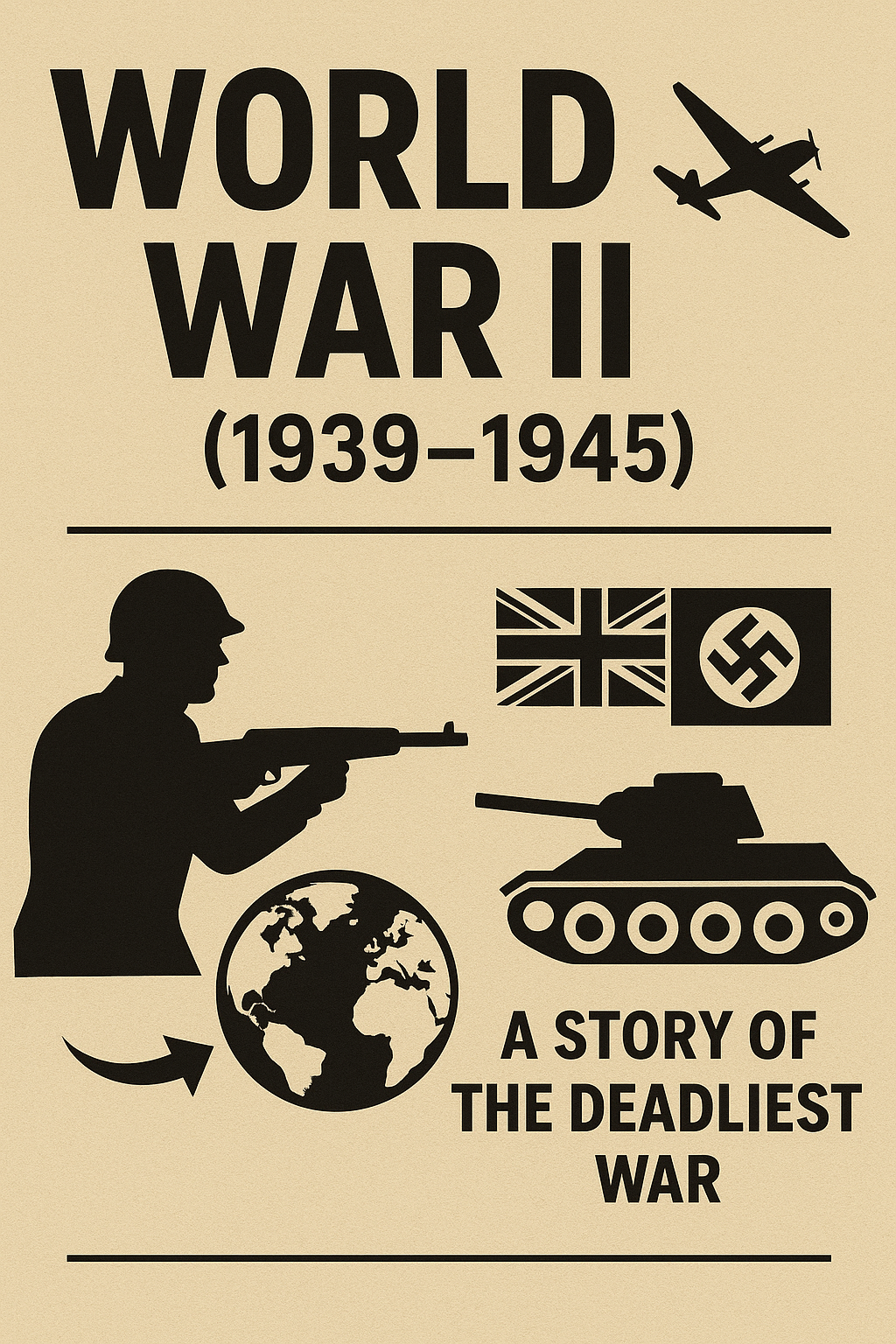
World War II was one of the most devastating conflicts in human history, lasting from 1939 to 1945. It involved most of the world’s nations and reshaped international politics, society, and global power. In this post, we’ll look at World War II in a story format — from the rise of Nazi Germany to the war’s aftermath.
🌍 The Rise of Nazi Germany
In the 1930s, Germany was recovering from economic depression and humiliation after World War I. Adolf Hitler rose to power, promising national revival but driven by extremist ideology. His vision of Aryan supremacy and expansionism laid the foundation for global conflict.
⚔️ The Invasion of Poland (1939)
On September 1, 1939, Germany invaded Poland. Britain and France declared war on Germany soon after — officially starting World War II. Within weeks, Poland was overrun, showcasing Germany’s military strength.
✈️ The Battle of Britain (1940)
After conquering much of Europe, Hitler turned to Britain. The Luftwaffe launched a massive bombing campaign. But under Winston Churchill’s leadership, Britain stood firm, and Germany failed to invade — marking a key turning point.
🔥 Operation Barbarossa (1941)
In June 1941, Hitler launched Operation Barbarossa, invading the Soviet Union. Initially successful, the Germans advanced rapidly. However, the Soviet resistance and harsh winter turned it into one of the bloodiest battles in history.
🌊 Pearl Harbor and U.S. Entry (1941)
On December 7, 1941, Japan attacked the U.S. naval base at Pearl Harbor. This drew the United States into the war, drastically shifting the balance of power in favor of the Allies.
🪖 The D-Day Invasion (1944)
On June 6, 1944, Allied forces launched the D-Day invasion in Normandy, France. This massive operation opened the Western Front and began the liberation of Nazi-occupied Europe.
🏳️ The End of the War (1945)
- Europe: As Allied forces closed in, Hitler committed suicide on April 30, 1945. Germany surrendered on May 8, 1945 (V-E Day).
- Pacific: The war ended after the U.S. dropped atomic bombs on Hiroshima and Nagasaki in August 1945. Japan surrendered on August 15, 1945 (V-J Day).
☠️ Aftermath of World War II
- Human Cost: 50–80 million deaths, the deadliest conflict in history.
- United Nations: Formed in 1945 to promote peace and prevent future wars.
- New World Order: The U.S. and Soviet Union emerged as superpowers, leading to the Cold War.
- Legacy: WW2 accelerated advancements in technology, medicine, and diplomacy — but also highlighted the devastating cost of war.
✨ Lessons from World War II
World War II reminds us of the dangers of aggression, racism, and unchecked power. It also underscores the importance of diplomacy, cooperation, and peace-building among nations.
📌 Quick Facts
- Years: 1939–1945
- Axis Powers: Germany, Italy, Japan
- Allied Powers: United States, Britain, Soviet Union, France, China
- Death Toll: 50–80 million
- Turning Points: Battle of Britain, Stalingrad, D-Day, Hiroshima & Nagasaki